The AI economy is a stack, and its scarce ingredient keeps sinking toward the bottom floors — from models, to chips, to power and machines. The top of the stack is bits — America's home game. The bottom is atoms — China's, and most densely the Greater Bay Area's. Closing the gap between attention and reality is what Novula does.
Long before a model writes a single sentence, something has to generate the electricity, forge the chips, build the factory, and — increasingly — move the robot. Five floors, one building.
Software that acts — and now, machines that act in the physical world.
The models themselves. The floor everyone photographs.
Vast data centers where the engines are racked, cooled, and run day and night.
The chips that do the thinking — and the memory that feeds them.
AI is the most electricity-hungry technology ever built. Nothing above runs without it.
You notice the top floor — but the building is only ever as tall as its foundation will bear.
For a decade the bottleneck kept changing floors — algorithms, then chips. It's still sinking. The new scarcity isn't intelligence; it's electricity, and the machinery that turns intelligence into action. That's a different contest entirely.
The real "why China" isn't a slide of statistics. Every floor the AI economy descends moves onto ground China spent twenty years building while the rest of the world wasn't looking.
The more you build, the cheaper each one gets — and the know-how pulls together in one place. It's why China's lead in solar, EVs and drones became near-total, not marginal.
You can rent compute, license a model, or source chips. You cannot rent twenty years of grid overbuild.
Each export control speeds China's drive to build its own — chips, memory, robot components. The wall makes the muscle.
A shrinking workforce gives China a reason to deploy physical AI at a scale few other places share.
America still owns the two things that may matter most: the intelligence ceiling, and the capital funding the entire build-out. The serious counter-argument is that intelligence is the master lever — that enough of it can solve the atoms problems. We take that seriously. So our claim is deliberately narrow. We do not say China wins AI. We say the world is fixated on the model floor and underpricing the physical floors it is about to depend on — and those floors are China's, and most densely the Greater Bay Area's. That gap between attention and reality is the opportunity. Closing it is what we do.
And this is not a story about America stumbling. It's a patient, decades-long bet on the physical foundation of technology, vindicated by a wave nobody could have named in advance. China didn't out-sprint the frontier. It built the ground floor — and the whole industry is now discovering it needs one.
Nvidia's Jensen Huang calls physical AI — intelligence that leaves the screen and enters the world — the next frontier, a market he sizes in the trillions. Take him at his word and ask the obvious question: where on earth should you stand to catch that wave?
America builds the brain.
The Bay Area builds the body.
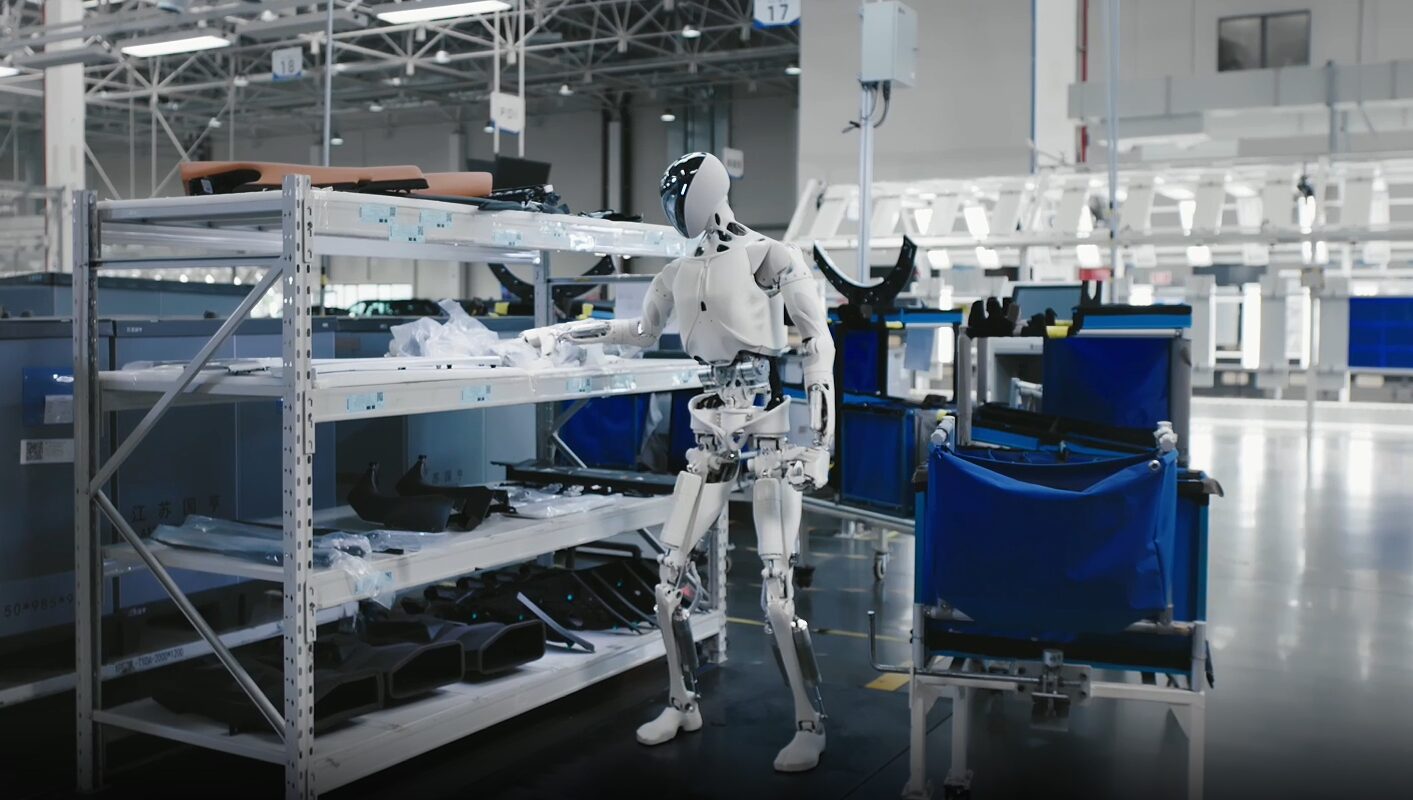
If physical AI is the next frontier, the GBA isn't near the answer. It is the answer.
One honest note, because credibility matters more than hype: today's robots are early — the best industrial humanoids still work at a fraction of human efficiency, and China dominates the manufacturing base, not yet the capability frontier. But manufacturing dominance is exactly the advantage that compounds. Ask solar. Ask EVs. Ask drones.
Three tiers, one methodology. The Map — how the AI economy is built. The Thesis — its center of gravity is descending to the physical, and the physical is the GBA's. The Vehicle — the four ways we take you there.
Step inside the factories, labs and supply chain the thesis describes. Explore the tours →
A selective, live-in program where the worldview becomes working knowledge. See the bootcamp →
For founders ready to act on the thesis — from prototype to scale, on the ground floor itself. See the incubator →
For a small circle of partners, we turn the gap between attention and reality into positions. Investor access →
Underneath all four runs the same method — Understand → Curate → Immerse → Connect. Map → Thesis → Vehicle is the why; the Method is the how.
The thesis takes a page to read and a week to believe. Start with a tour.
Written as of mid-2026. Humanoid shipment share per Omdia / Bloomberg (Chinese firms shipped the large majority of the ~13,000 humanoids delivered in 2025); "physical AI" framing and market sizing attributed to Nvidia CEO Jensen Huang (CES & GTC keynotes); Nvidia's Isaac GR00T reference humanoid pairs Nvidia compute with a Unitree body. Figures in this space move monthly — we update this page as they do.