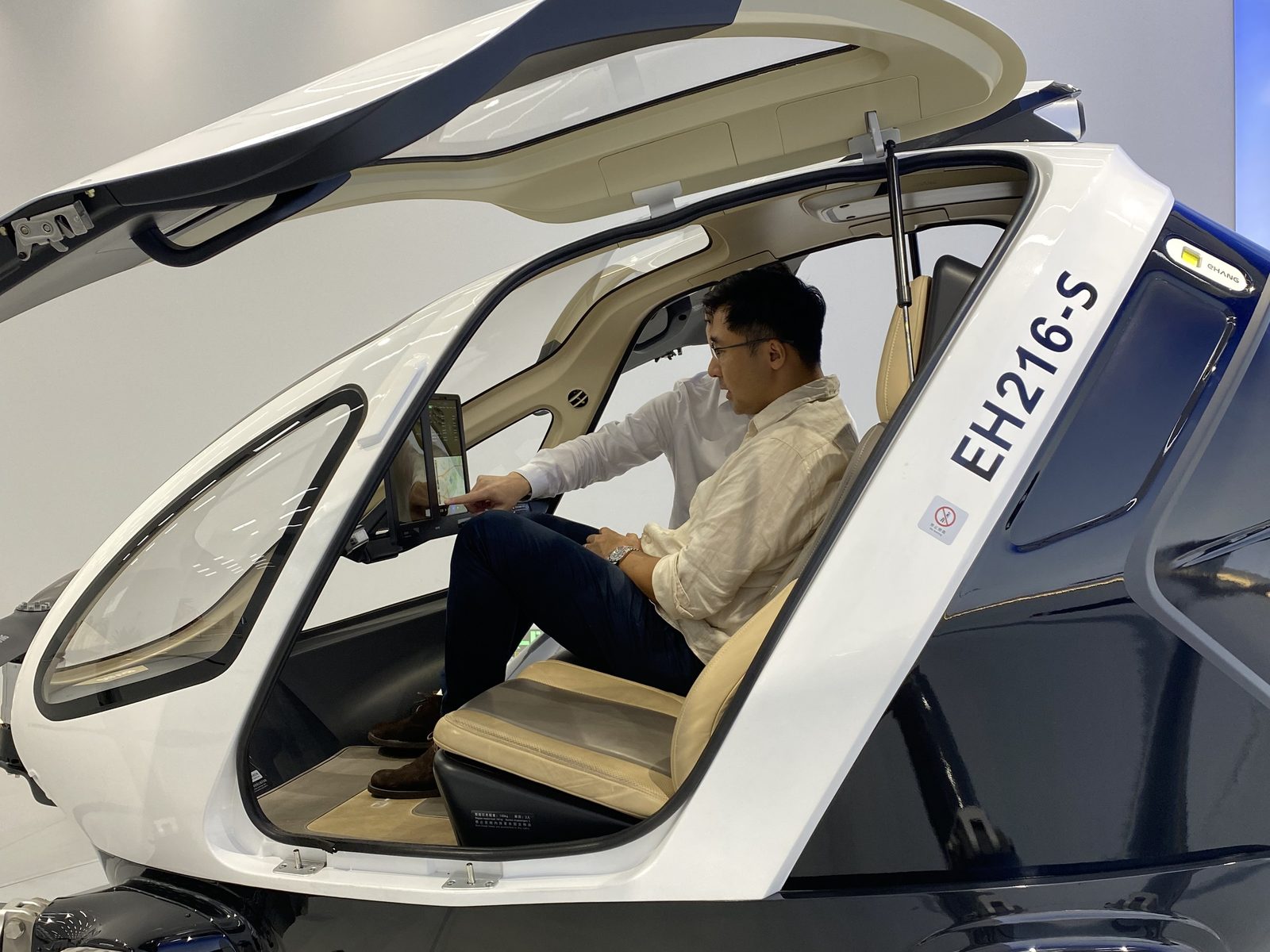
Last week I sat inside a flying taxi and did what everyone who grew up on helicopter movies does: I looked for the controls.
There aren’t any.
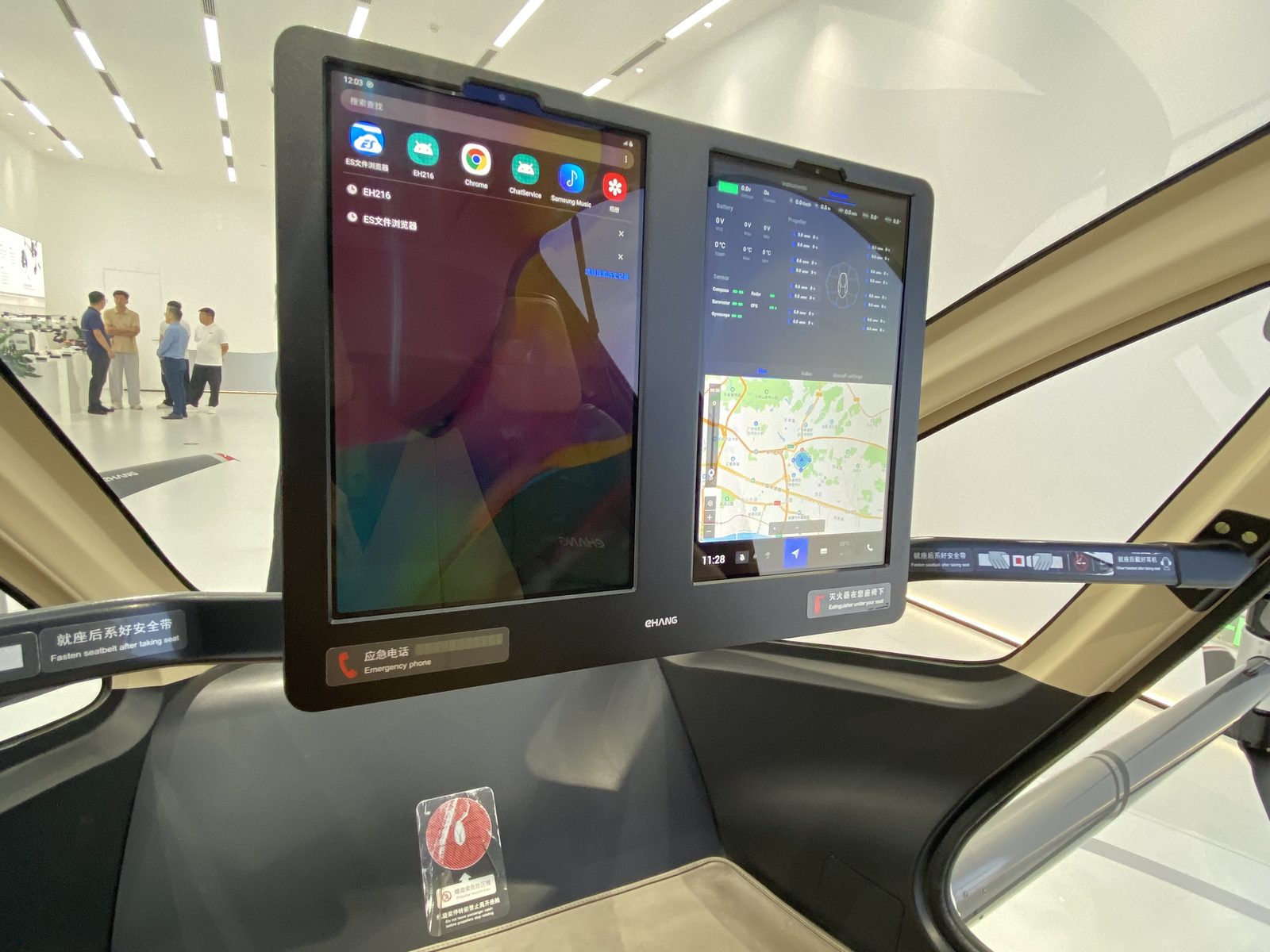
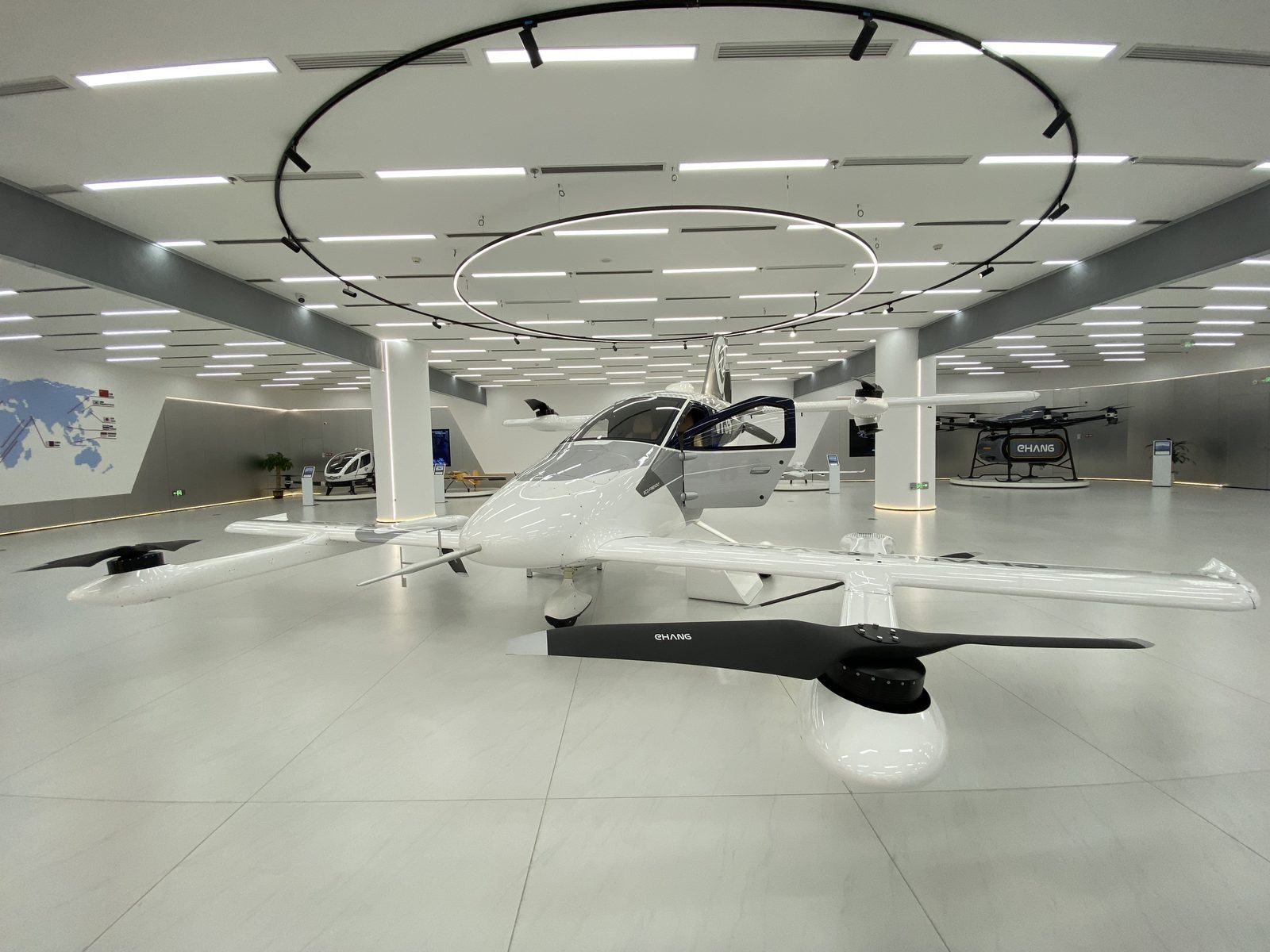
The EH216-S has two seats, gull-wing doors, and a tablet. No yoke, no pedals, no instrument cluster blinking like a Christmas tree. The interface is a map. You choose where you want to go. That is the entire job description of being aboard.
Nobody explained this to me. Nobody needed to — and that’s the achievement. I’ve sat in helicopters where the walkthrough takes twenty minutes. Here, the machine has quietly adopted the design language of a ride-hailing app rather than a cockpit, and your thumbs already know the way. The nearest thing I can compare it to is sitting in one of Tesla’s Cybercabs: the absence of controls isn’t a gap in the interior. It is the interior.
The demo flight got cancelled — low cloud, and the operator wouldn’t fly. I’ll admit I was disappointed for about a minute. Then it occurred to me that I’ve watched a hundred flawless eVTOL demo videos, and none of them told me what that cancellation did: this thing is regulated like an aircraft, with weather minima and someone empowered to say no. In an industry drowning in renders, a scrubbed flight is oddly reassuring evidence of adult supervision.
The wall nobody photographs
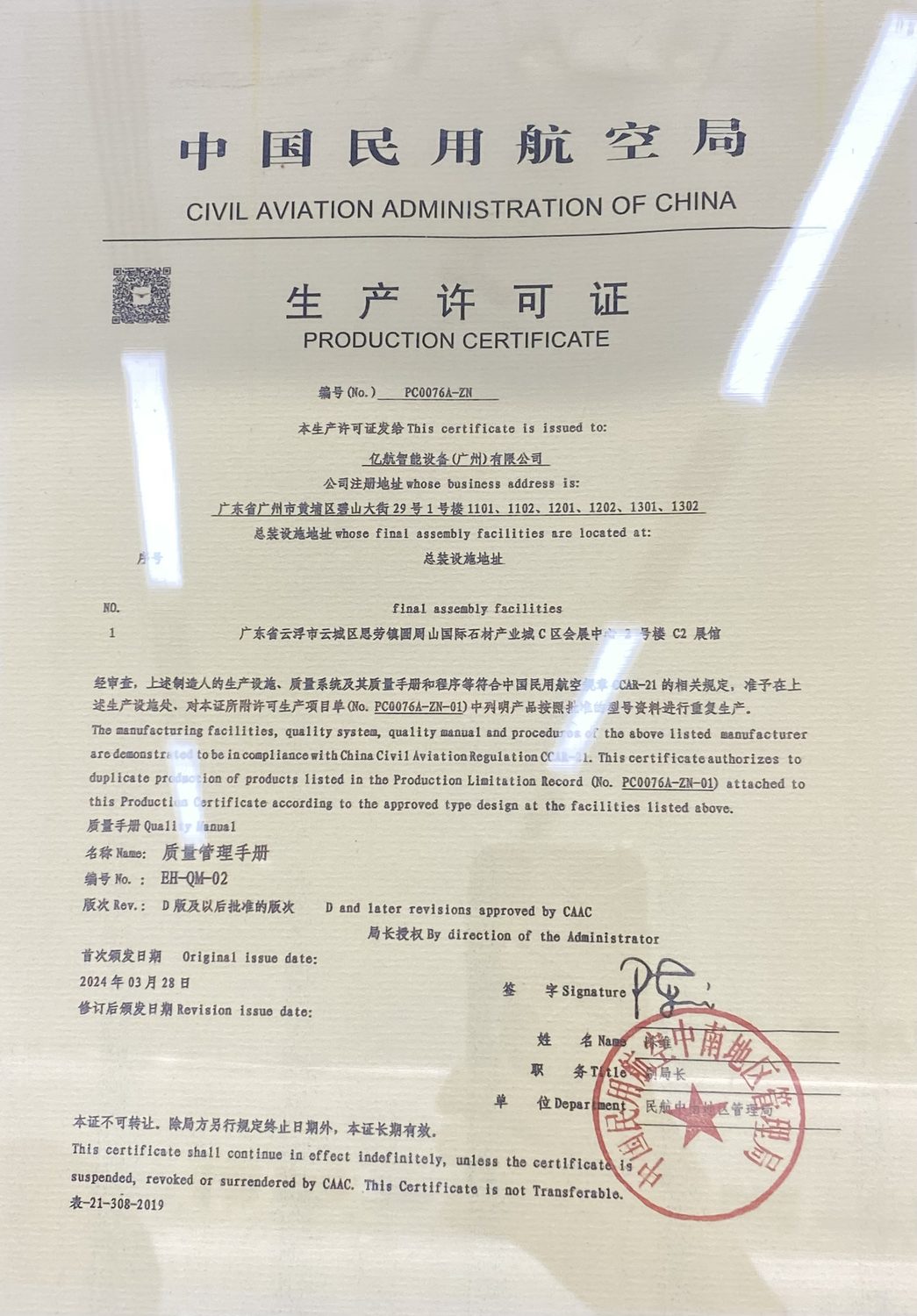
Every visitor photographs the aircraft. I ended up photographing three framed documents on the wall — and the longer I stood there, the more convinced I became that they were the real exhibit.
A Type Certificate, issued October 2023: the design is approved. A Production Certificate, March 2024: the factory is approved to replicate that design. An Air Operator Certificate, March 2025: a company is approved to fly people commercially. This is the same ladder Boeing and Airbus climb for every aircraft — completed here, for an autonomous passenger drone, at roughly one rung a year. Nobody else in the world — no company under the FAA, none under Europe’s EASA — yet holds the full set for an aircraft like this.
And then the detail I keep thinking about. On that operator certificate there’s a row of checkboxes. Person onboard — ticked. Passenger transportation — not ticked. Certified to carry humans; not yet certified to run scheduled taxi routes. An entire industry’s next chapter lives in the space between those two boxes, and I find that single sheet of paper more informative than every keynote about flying cars I’ve ever sat through.
What the man who flies planes said
Our host was Eddie Lin, EHang’s Director of Global Markets — an aviation-industry veteran and a licensed pilot, which makes his answer to my obvious question worth passing on. Where’s the bottleneck? Not the technology, he said. The technology is largely solved. The bottleneck is regulation — and he said it without complaint, the way a pilot would: aviation regulators are conservative because falling out of the sky is not a failure mode you patch next sprint. Every country runs its own process. Every process is slow. That’s the terrain, not an obstacle on it.
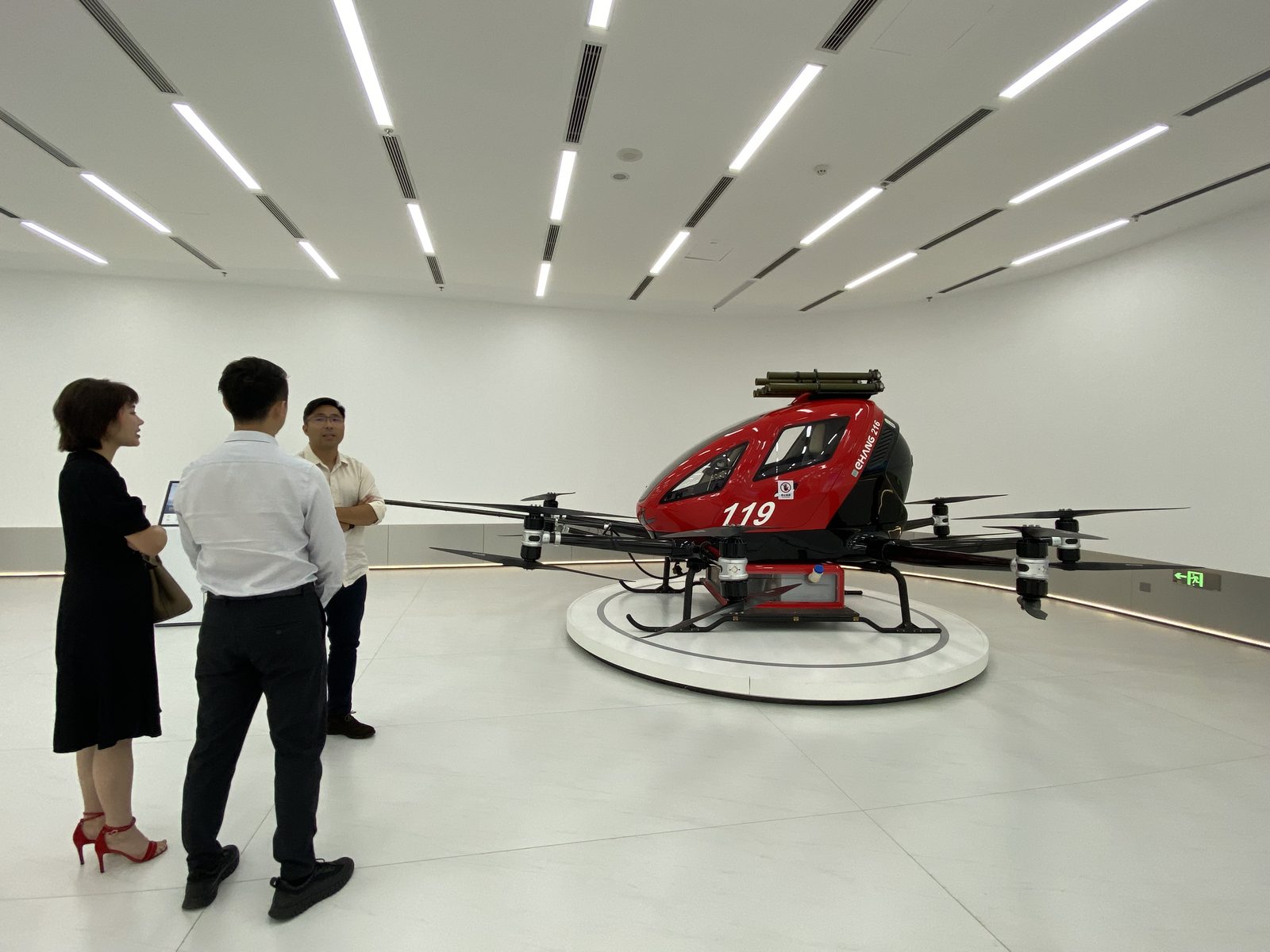
The product family in the showroom backs him up — this is not a company waiting for permission to have ideas. There’s a fire-fighting variant, the EH216-F, in fire-engine red. A few months after the Tai Po fire in Hong Kong — a tragedy still raw for anyone connected to the city — that variant stopped reading as a showroom curiosity to me. A hose that flies changes the geometry of a high-rise fire. We were told EHang donated one to the Hong Kong government in the aftermath; I haven’t found that in the public record, so take it as showroom conversation. What is public: EHang was selected for Hong Kong’s Low-Altitude Economy “Regulatory Sandbox X” trials this summer. The machines and the paperwork are both moving toward the city where I live.
And beside it sat the VT — a fixed-wing model with serious range and, of all the mundane miracles, a luggage compartment. Same one-tablet simplicity. When a technology grows a boot for your suitcase, someone is thinking about customers, not demos.
Inevitable is not the same as imminent
So, after a day in that showroom: do I think the “low-altitude economy” — Beijing’s own name for this industry — is real? Yes. Do I think it’s arriving overnight? No. Anyone who tells you otherwise is selling something faster than an aircraft certification.
But here’s the thing I couldn’t un-see, and regular readers will recognize the shape of it. An eVTOL is batteries, electric motors, flight controls, sensors, software — which is to say, it’s the electric-vehicle supply chain, rearranged skyward. The industry that spent two decades maturing those components to automotive volumes and prices sits in this river delta. That’s why this showroom is in Guangzhou and not somewhere else. Add the second ingredient — a regulator willing to go first, checkbox by careful checkbox — and you get my honest summary: not fast, but hard to reverse. Inevitable, just not imminent.
The rebuttal deserves its paragraph, as always. Other regulators moving slower are not necessarily wrong — some of that caution is the point of having regulators. Nobody, including EHang, has yet proven what a flying taxi ride must cost to be a business rather than an attraction. And today’s approved operations are hops and loops, not commutes. The claim I’m making is narrow: the learning curve — technical, regulatory, operational — is being climbed here first, and learning curves compound.
The checkbox question
The flying taxi was the least interesting thing in the room. The interesting things were a tablet that made flight feel like an app, a scrubbed demo that proved the rules are real, and an unticked checkbox quietly holding the industry’s next act.
Here’s the question I brought home, and it works for any industry: in your field, what’s on display in the showroom — and what’s actually framed on the wall?
If you’d rather stop guessing at the answer from a distance: rooms like this one are exactly where we take the founders, executives, and investors who join our Greater Bay Area innovation weeks. Some doors here don’t open from the outside. Walking through them, with the person who holds the keys explaining what you’re looking at, changes what you think is possible — it did for me, again, last week.
Jason Chan is the founder of Novula. This is a field note — the on-the-ground companion stream to our analysis series The Stack. To stand in these rooms yourself, explore our innovation tours.