You’ve probably used a chatbot this week. Maybe this morning. You typed a question into a text box, and something that reads like a mind typed back.
Notice how it feels: weightless. Instant. Practically free. Words in, words out — no smoke, no noise, nothing you could stub a toe on. It feels like the most immaterial technology ever invented.
It is the opposite. That answer you got this morning has a weight you never see. Before a model writes a single sentence, something has to generate the electricity, forge the chips, build the building that houses them, and — increasingly — move the robot.
Here’s a simpler way to hold all of that in your head at once, and it’s the map for everything I’m going to write in this series.
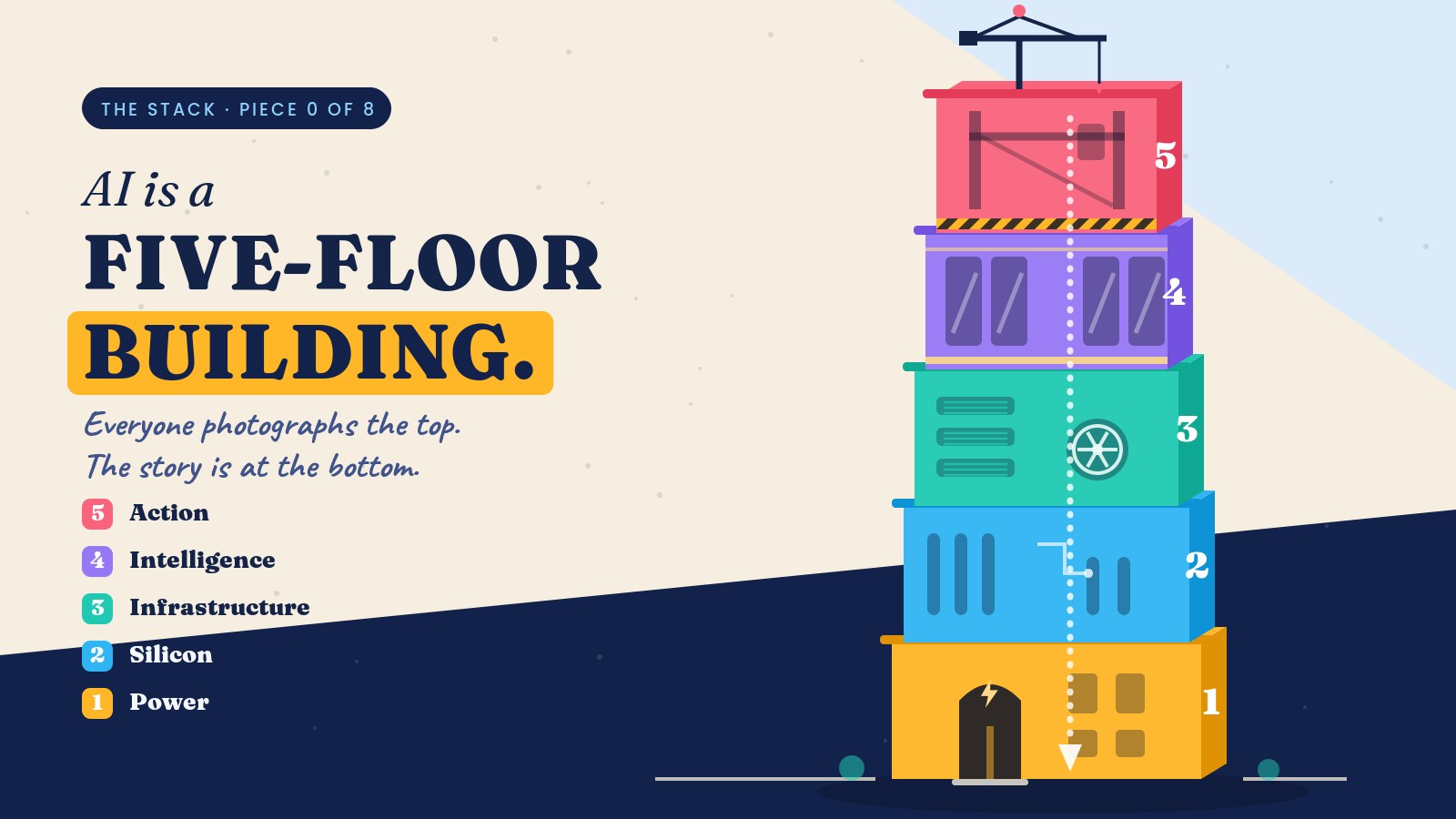
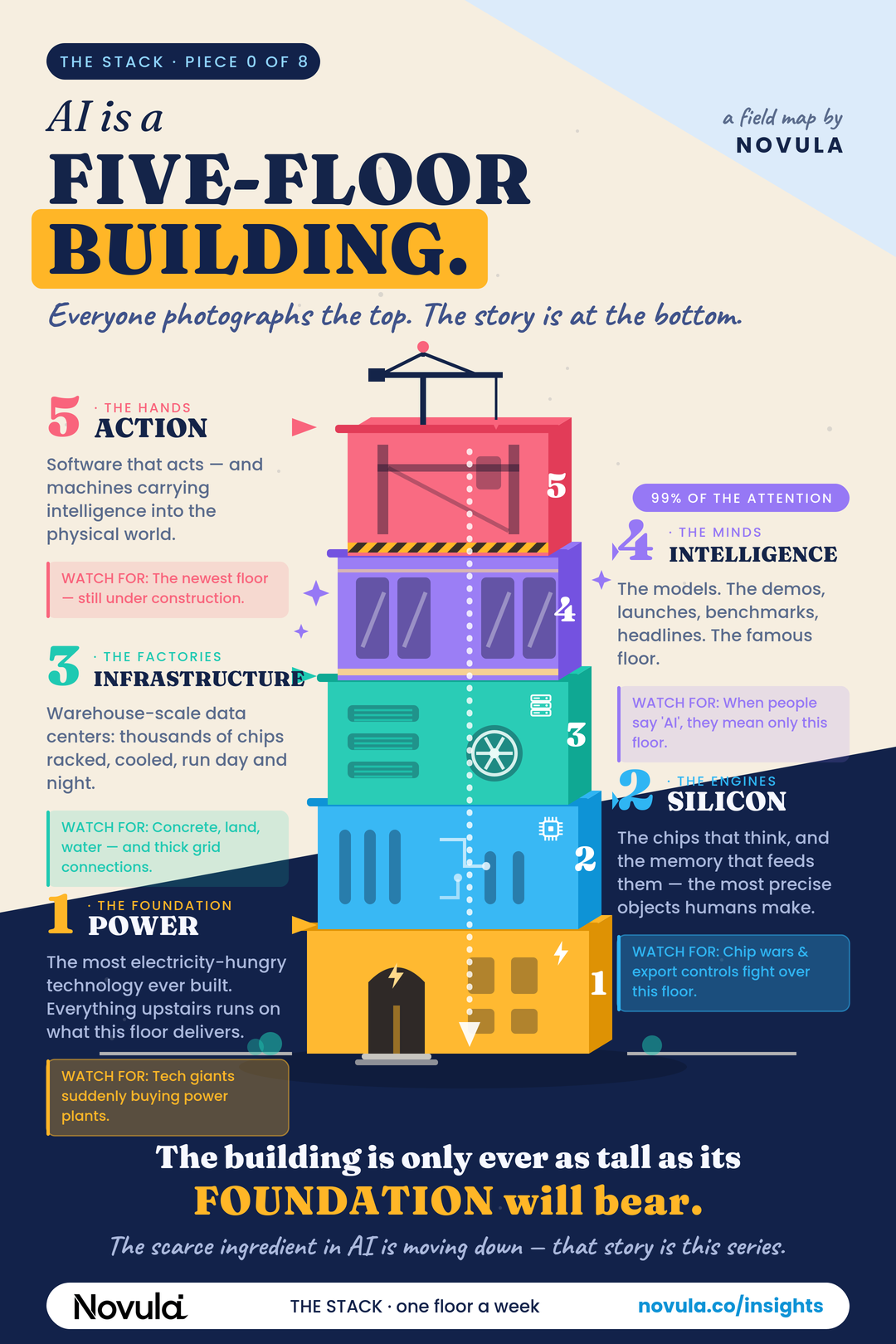
The AI economy is a building with five floors.
Floor 1 — Power. The foundation.
AI is the most electricity-hungry technology humans have ever built. Training a frontier model, and then answering billions of questions a day, consumes power on the scale of cities — not laptops. Every floor above this one runs on what the foundation can deliver, and none of them run at all without it. When you hear that a technology company is suddenly very interested in power plants, this floor is why.
Floor 2 — Silicon. The engines.
One floor up sit the chips — the specialized processors that do the actual thinking, and the equally specialized memory that has to feed them fast enough to keep up. These are among the most precise objects humans manufacture, made in a handful of factories whose machines are themselves close to miracles. When you read about export controls and chip wars, this is the floor being fought over.
Floor 3 — Infrastructure. The factories.
The engines have to live somewhere. Floor three is the data centers — vast, warehouse-sized “AI factories” where tens of thousands of chips are racked, wired, cooled, and run day and night. If Floor 2 is the engine, Floor 3 is the plant that houses the engine and never switches it off. It is concrete, steel, land, cooling water, and above all, a connection to Floor 1 thick enough to matter.
Floor 4 — Intelligence. The minds.
Now the famous floor: the models themselves. The chatbots, the image generators, the systems with names you know. This is the floor everyone photographs — the demos, the launch events, the benchmark charts, the breathless headlines. When people say “AI,” they almost always mean this floor and this floor only.
Floor 5 — Action. The hands.
And at the top, the newest floor, still under construction: software that doesn’t just answer but acts. Systems that book, buy, file, and fix — and now, machines that carry intelligence out of the screen and into the physical world. This floor is where AI stops being something you read and starts being something that happens around you. It deserves — and will get — pieces of its own.
The thing about buildings
Stand back from the whole structure and one observation matters more than any other:
You notice the top floors, but the building is only ever as tall as its foundation will bear.
Almost all of the attention — the money, the headlines, the national anxieties — points at Floor 4, with an excited glance at Floor 5. The minds and the hands. The photogenic floors.
Almost nobody looks down. Yet every impressive thing that happens upstairs was made possible — or made impossible — by decisions someone took years earlier about concrete, copper, and kilowatts. A model is an achievement. The floors beneath it are a precondition. Miss that distinction and the whole AI story becomes very hard to read correctly.
And there’s one more thing, which I’ll only plant here and argue properly as we go: the scarce ingredient in AI — the thing that decides who can build more of it — hasn’t stayed on one floor. Over the past decade it has been quietly moving. And the direction it’s moving is down.
What that means, who it favors, and what it has to do with the part of the world where I live and work — that’s the series.
The plan from here
One floor a week, bottom to top: power, then silicon, then the factories, then the minds, then the hands — and then two payoffs where the argument lands somewhere unexpected. If you’d rather see the whole map at once, it’s on one page here: The Novula Lens. And if you want a preview of where this ends, it ends somewhere I’ve already been: standing on a factory floor, watching a robot work a shift while nobody looked up.
The top floor gets the photographs. The building gets built somewhere else.
See you on the ground floor.
This is Piece 0 of The Stack, a series unrolling the Novula Lens — our thesis on how the AI economy is actually built — one floor at a time. Novula takes executives, founders, and government delegations to stand where the stack is being poured: explore our programs or read the full thesis.